Expressvpn Glossary
Data sanitization

What is data sanitization?
Data sanitization is the process of deliberately, permanently, and irreversibly erasing or destroying data from a storage device or physical media so it can’t be recovered.
How does data sanitization work?
Data sanitization involves a series of steps to permanently remove sensitive data:
- Identification of storage endpoints: The organization identifies the devices or media that store sensitive information and require sanitization.
- Assessment of requirements: Next, they review internal policies, regulatory obligations, and applicable data erasure standards to define the required level of sanitization.
- Selection of a sanitization method: The organization selects a sanitization method that meets the defined requirements and aligns with the storage type.
- Application of sanitization measures: The chosen method is then applied using approved tools, software, or procedures to ensure proper execution.
- Verification of data removal: Finally, verification is conducted to check whether the data has been permanently removed. This typically involves specialized software and validation procedures aligned with recognized standards.
Data sanitization methods
Common data sanitization methods include:
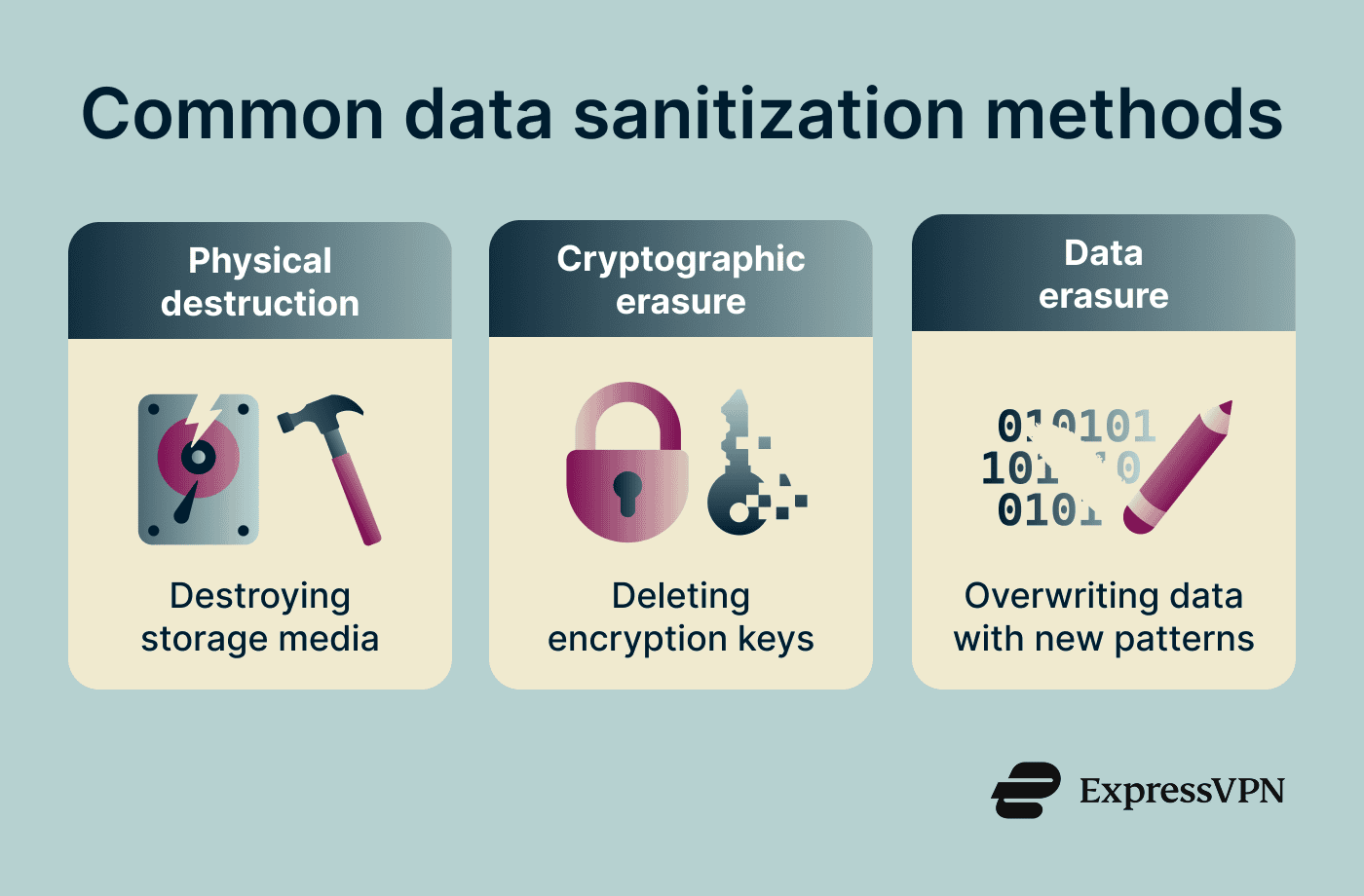
- Physical destruction: Uses industrial shredders and crushers to destroy storage media such as hard drives, DVDs, or tapes, or degaussers that apply strong magnetic fields to magnetic media.
- Cryptographic erasure: Encrypts stored data and then permanently deletes the encryption key, making the data unreadable and effectively unrecoverable.
- Data erasure: Securely overwrites digitally stored information with new data patterns, replacing the original data at the byte level to prevent it from being reconstructed.
Why is data sanitization important?
Data sanitization is essential for reducing the risk of data breaches and data leaks because simply deleting files often doesn’t fully remove them from storage devices. If a malicious actor gains unauthorized access to a device or physical record that still contains sensitive information, the data may be recovered using specialized tools and then exploited.
Additionally, data sanitization is often required to comply with privacy standards and industry regulations. Failing to properly dispose of stored data can result in non-compliance, which may lead to financial penalties, legal consequences, or reputational damage.
Data sanitization vs. data deletion
Deletion removes the index or pointer that the operating system uses to locate a file, but the underlying data remains on the storage medium until it is eventually overwritten by new information. Until that overwrite occurs, deleted files can be recovered with widely available data recovery software.
Data sanitization goes beyond deleting visible files by eliminating the residual traces that persist in caches, temporary files, system logs, and metadata.
Further reading
- How to wipe a computer: Securely erase all data (step-by-step guide)
- How to properly dispose of your hard drives
- How to delete your hard drive browsing history
- How to encrypt a flash drive on Windows and Mac